
Famous people—Josephine Butler
An EFL lesson for middle-level students
May 2026. eflsuccess.com, Michael Krigline ⇔
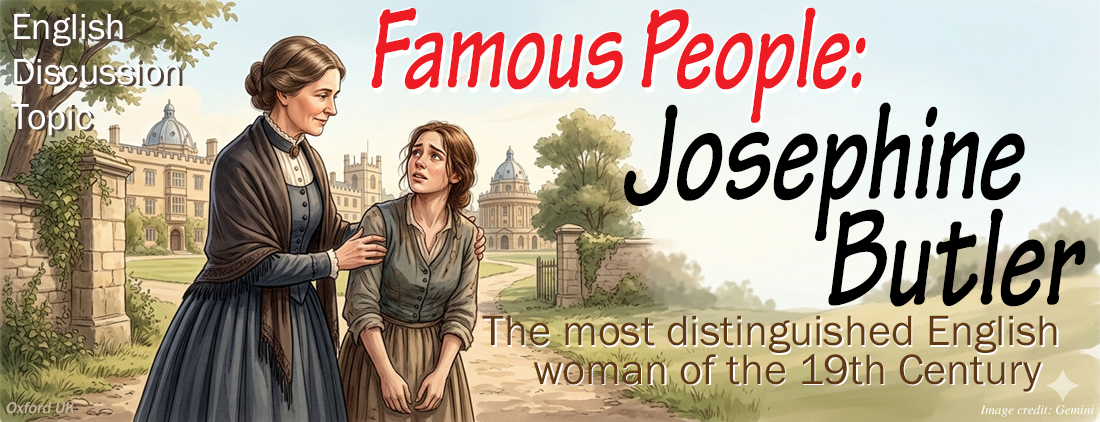
Warm up: Each student should name one form of charity. That is, name one way to give money, time, a skill, etc., to help the poor, sick, or others in need.
Click here for a shorter version of this lesson, for students with a lower English level (or teachers with less time to present it).
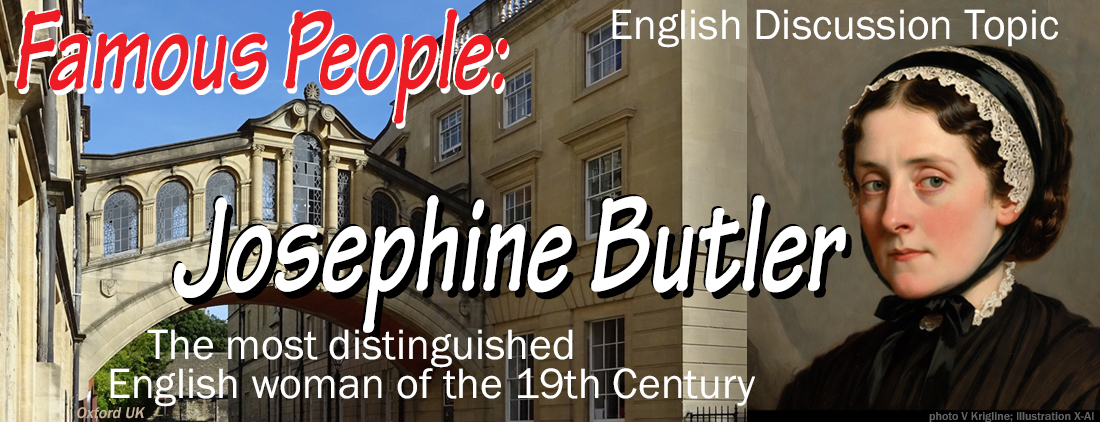
Josephine Butler (1828-1906)
Vocabulary terms are underlined and then defined below (I recommend that you start there!), followed by discussion questions.
If you’re a healthy, educated female who has ever voted, then you should be thankful for the home-schooled wife and mother Josephine Butler (1828–1906). Millicent Fawcett, a leader of the British suffragist movement, called Josephine Butler “the most distinguished English woman of the 19th Century,” though her tremendous influence is now largely forgotten.
When Josephine was growing up, women were excluded from most formal education in Britain. However, Josephine’s progressive father educated her at home (where she also learned French and Italian). Later in life, this education let her take advantage of her husband’s access to Oxford University’s world-class libraries.
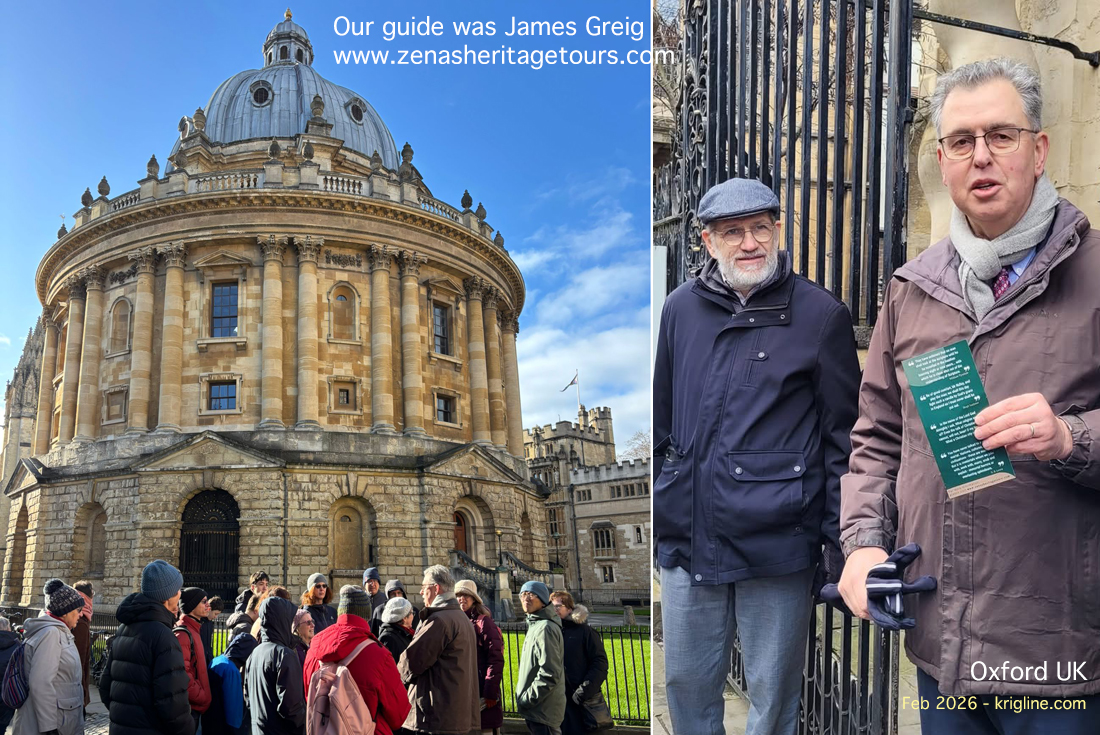
When her husband (George Butler, a classics scholar and cleric) moved them to Oxford, UK (1852), all of the teachers were men. Women were not even allowed to enroll as students. In fact, almost all teachers and students were unmarried, a long-standing rule that promoted dedication to scholarship. Sadly, this over-abundance of unmarried males, the era’s weak sense of morality, and lack of education/opportunities for women led to widespread prostitution. Josephine’s distinguished human rights achievements started with her compassion for these “fallen women,” whom the Butlers invited into their home for shelter and support. Josephine was outraged by sexual double standards, where men exploited women without consequence while women faced ruin.
Later, Josephine would be remembered for campaigns against the Contagious Diseases Acts (CDA), which targeted and humiliated “fallen women.” In the 1860s, she was an early advocate for women’s suffrage (the right to vote). In 1869 she founded the Ladies National Association, which in turn changed how people viewed women’s rights and public health. Her campaigns also led to women being allowed to attend college in the 1870s-1880s.
Josephine’s Christian faith was the driving force behind her enduring legacy as a social reformer and advocate for women and the vulnerable. Shaped by her mother’s fervent faith, Josephine had an intense prayer life and a profound sense of calling. Her faith helped her endure severe opposition in a male-dominated world. She viewed her work as a continuation of Jesus’ loving interaction with “prostitutes and tax collectors” (Matt 21:28-32)—souls precious to God and deserving of justice, compassion, and restoration. She famously said: “God and one woman make a majority.”
Sadly, secular feminists have long overlooked her because of her strong Christianity, while Christians ignored her for views considered “radical” at the time. But recent scholarship is increasingly attracted to both aspects of her passion (Christian faith and commitment to women’s rights).
In summary, Josephine Butler’s contributions helped lead to many of the opportunities modern women take for granted. She had a remarkable influence on higher education for women, women’s suffrage, and the protection of vulnerable women from exploitation and trafficking. Her Christian faith was the engine of her passionate pursuit of justice. Her life demonstrates how deep faith can change the world.
(See discussion questions and vocabulary below.) A few explanatory notes are also after the discussion section.
Vocabulary:
(*key terms) [Remember: sth = something; sb = somebody. If a definition starts with “=” you should memorize this one-word synonym ; click here for common English abbreviations]
- suffrage: the right to vote in public elections
- suffragist: a person who fights to extend the right to vote to more people (esp., advocates of women’s suffrage) ~ “Because of the work of many suffragists, women in the UK gained suffrage in 1928.”
- *progressive (educators): emphasizing individual instruction, informality, free-thinking, and other non-traditional ideas in the classroom (instead of making students memorize facts, spelling, “the right answer”, etc.)
- *scholar=student; sb who is being (or has been) formally educated to achieve a high level of understanding, insight, wisdom, etc.
- scholarship: the knowledge, work, or methods involved in serious studying ~ “Artificial intelligence is giving many scholars deeper access to scholarship than ever before.”
- scholarship: when someone pays some of the educational expenses for gifted students or athletes
- cleric: a member of the clergy, such as a Christian pastor, Islamic imam or Jewish rabbi ~ “In many places, a marriage in not considered legal until a cleric is involved.”
- prostitution: the work of someone who earns money by having sex for a fee
- fallen: this term isn’t used much anymore, but used to imply a fall/departure from a higher moral or social position; a sinner (one who has fallen short of God’s perfect standard)
- *outraged: describes sb who feels great anger and shock, especially over a moral issue
- *double standard: unfair rules; when you have one rule for somebody, but a different rule for somebody similar ~ “Ms. Butler was outraged about double standards for men and women.”
- *exploit (exploitation): to treat sb unfairly by making them do things that give them little in return ~ “For generations, prisons exploited people by making them work hard without pay.”
- ruin: complete destruction (in terms of financial or physical health, reputation, etc.) ~ “Unsuccessful in beating her opponent in an election, she decided to use her power and money to bring him to ruin.”
- *contagious: easily passed from one person to another (e.g., illnesses like a cold or flu)
- driving force: sb or sth that strongly influences people to do something ~ “Her hope to earn a PhD and great job was the driving force that kept her in the lab all summer.”
- *vulnerable: easily harmed or damaged
- fervent=intense; believing sth very strongly and sincerely
- calling: a belief that you have been appointed or strongly directed (e.g., by God) to a role, career, way of life, etc.
- *secular: not religious; not related to or under the authority of religious leaders
- feminist: one who is outspoken about women’s rights to the same opportunity, pay, etc. as men
- *radical: different, new, and against what most people think or believe
- trafficking: illegally taking and selling things or people to/in another place ~ “Unguarded borders enable traffickers to smuggle drugs and traffic children to markets abroad.”
Photos




Vocabulary matching:
Match the words from the article on the left with their synonyms on the right. Are your answers the same as other students’?
1. suffrage      a. easily harmed
2. scholar       b. intense
3. cleric        c. right to vote
4. outraged      d. student
5. fervent       e. pastor
6. vulnerable    f. angry
Media (optional):
If you have time, listen to this interesting podcast:
- Interview with Sarah Williams https://open.spotify.com/episode/6RCPaWCPCbNswjIq8zcLha?si=8629fc2f4d874717&nd=1&dlsi=43e3c7c7aba74890
Discussion:
Are there any terms you want to ask your teacher about? (As always, please do not answer any question that makes you uncomfortable.) If you have a lower English level, ask your partner “content questions” which have answers in the text.
- Why does the author say that modern women should be thankful to Josephine Butler? What specific things do we take for granted today that she helped change?
- Josephine Butler was home-schooled because women were excluded from most formal education. How has access to education for women changed in your country or culture over the past 100 years?
- The article mentions “sexual double standards.” What does this mean? Why was Josephine Butler so angry about it?
- Josephine fought against the Contagious Diseases Acts (CDA), which punished female prostitutes but didn’t punish the men who hired/exploited them. Do you think similar double standards still exist today in any area of life? Explain.
- The article says Josephine’s Christian faith was the “driving force” behind her work. Do you think faith can be a strong motivation for social change? Why or why not? Give examples if possible.
- Both Christians and non-Christians have overlooked Josephine’s contribution. Why? Do you think that faith and social justice can work together or should they stay separate?
- Josephine Butler famously said, “God and one woman make a majority.” What do you think she meant by this? Do you agree that one determined person can make a big difference? Can you think of any other historical figures who showed this?
- What did you find most inspiring or surprising about Mrs. Butler’s life? Is there any lesson from her story that you can apply to your own life or community?
Still have time? Discuss discuss this proverb from the Bible:
“Open your mouth for the mute, for the rights of all who are destitute. Open your mouth, judge righteously, defend the rights of the poor and needy.” (Prov 31: 8-9 ESV)
If there are any words in this passage that you don’t understand, ask your teacher. How does this proverb relate to Mrs. Butler’s work? What are some modern examples of people who are “mute” or “destitute” and therefore need help?
Notes:
- Millicent Fawcett (1847-1929) was a key figure in the peaceful, law-abiding wing of the suffrage campaign (via the National Union of Women’s Suffrage Societies, which she led from 1897 to 1919), contrasting with the more militant suffragettes. She witnessed partial women’s suffrage in 1918 and full equality in 1928, just before her death.
- Josephine’s father, John Grey, was a cousin of Prime Minister Earl Grey (Charles Grey, the 2nd Earl Grey, PM 1830 to 1834), remembered for helping to reform the British electoral system and abolish slavery within the British Empire. A Chinese mandarin presented him with a blend of tea flavored with bergamot, giving birth to the famous “Earl Grey” tea that bears his name.
- George and Josephine Butler had four children together, though two died young.
- X-AI (Grok) helped with research, to create discussion questions, and to provide a “lower level” version.
Sources include
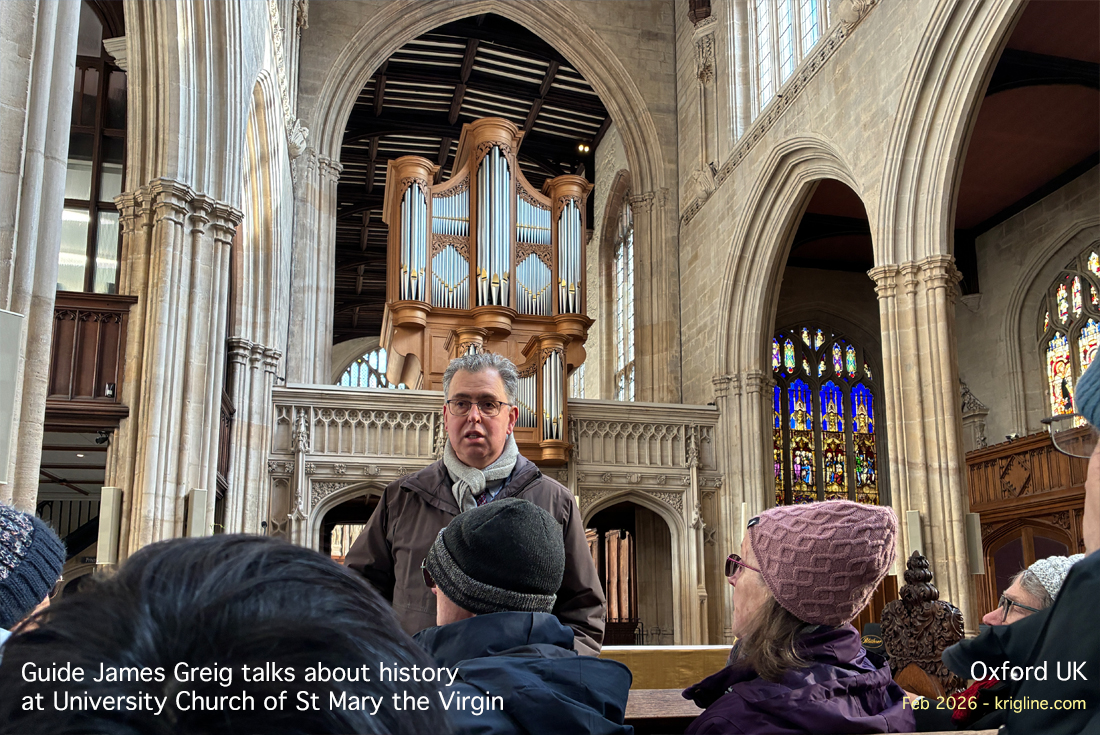
- Comments by tour guide James Greig, Zenas Tours
- Podcast with Dr. Sarah Williams (see “Media” above)
- DuckDuckGo AI
- X-AI (Grok), which provided the following references…
- Primary Sources (Butler’s Own Writings or Contemporary Accounts) ~ These are especially strong for direct details on her education and Oxford life, as she reflected on them in her memoirs. Many are accessible online via archives like HathiTrust, Project Gutenberg, or university libraries.
- – **Butler, Josephine E. Recollections of George Butler** (1892). ~ This is her biography of her husband. It’s a key primary source for the Oxford period (1852–mid-1850s/early 1860s). Available in reprints or archives.
- – **Butler, Josephine E. An Autobiographical Memoir** (edited by George W. and Lucy A. Johnson, 1909/1913 editions).
- – **Butler, Josephine E. Personal Reminiscences of a Great Crusade** (1896).
- Wikipedia
- Jane Jordan. Josephine Butler (2001)
- Helen Mathers. Josephine Butler: Patron Saint of Prostitutes (2014)
- Sarah Williams. When Courage Calls (2024) https://www.hachette.co.uk/titles/sarah-c-williams/when-courage-calls-josephine-butler-and-the-radical-pursuit-of-justice-for-women/9781399803731/
For additional lessons on famous people, visit: https://famouspeoplelessons.com
Matching (answers): 1c, 2d, 3e, 4f, 5b, 6a
Original materials on EFLsuccess.com ©Michael Krigline, some rights reserved. Our resources were created for our students under the understanding of “fair use” for educational resources. As far as we are concerned, website visitors are allowed to print/copy these materials for personal or classroom use. For details, see our Website Standards and Use Policy. We also encourage you to visit Michael’s inspirational website: wp.krigline.com.
~ ~ ~ ~ ~ ~ advertisement ~ ~ ~ ~ ~ ~